
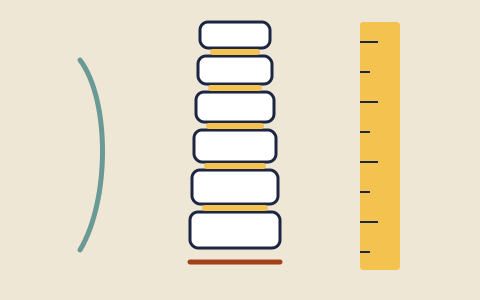
Posture comes up constantly in advice about height, usually with the promise that "fixing" it will add centimetres. The honest picture is different, and more useful. Posture changes how tall you stand at a given moment; it does not change the length of your bones. The more important height question for adults is not how to gain it but why some people lose it later in life, and what health agencies say about protecting the spine.
Can posture make you taller?
Your height is set by the length of your bones, including the bones of your spine and legs. The National Institute of Arthritis and Musculoskeletal and Skin Diseases (NIAMS) explains that the growth plates which lengthen bones close at the end of adolescence and are replaced by solid bone. After that, bone length does not increase.
Standing up straight rather than slumping changes how much of that length shows when you are measured or seen. That is the whole of what posture can do for height: it affects how tall you stand, not how tall you are. None of the health sources this site relies on describes posture exercises, braces or devices as a way to increase adult height, and any product sold on that promise should be read with the warning signs in the guide on height myths in mind.
That does not make posture unimportant. It just means it belongs in conversations about comfort, back health and fitness, which are outside the scope of this site, rather than conversations about growing taller.
Scoliosis is not caused by posture
A common worry among parents is that a child's slouching will "bend" their spine. The NHS addresses this directly in its guidance on scoliosis, a condition in which the spine twists and curves to the side. It says scoliosis most often starts in children aged 10 to 15, and that in around 8 in every 10 cases the cause is unknown. This most common type, idiopathic scoliosis, cannot be prevented and is not thought to be linked to bad posture, exercise or diet. Genes may make it more likely, as it sometimes runs in families.
The NHS advises seeing a GP if you think you or your child has scoliosis, and says that while it is unlikely anything serious is wrong, it is best to have it checked. Treatment depends on age, how large the curve is and whether it is likely to get worse; many people need no treatment, and older children may wear a brace until they stop growing. The NHS also says it is not clear whether back exercises help scoliosis, though general exercise is good for overall health.
So a slouch is not the same as scoliosis, and good posture habits are not a way to prevent it. If a child's shoulders, hips or back look uneven, the next step is a doctor, not a posture programme.
Why some adults lose height
Losing height in later life is real, and it can be a sign worth paying attention to. The main cause the health agencies describe is osteoporosis.
MedlinePlus explains that bone is living tissue: the body constantly breaks down old bone and replaces it with new bone. Osteoporosis develops when more bone is broken down than replaced, leaving bones weaker and more likely to break. NIAMS calls it a "silent" disease because there are usually no symptoms until a bone breaks. Fractures are most common in the hip, the wrist and the vertebrae, the bones of the spine.
Fractures of the vertebrae are where height comes in. NIAMS lists severe back pain, loss of height, and a stooped or hunched posture called kyphosis among the symptoms of a spinal fracture. The NHS describes how some older people develop a characteristic stooped posture when bones in the spine have broken and can no longer support the body's weight properly. The NHS also notes that with very fragile bones, something as small as a cough or sneeze can cause a partial collapse of a bone in the spine.
In other words, a stoop in later life is not always "bad posture". It can reflect changes in the bones themselves, and that is a medical question.
In one line
Posture habits do not change your bone length. Losing height or developing a stoop in later life can be a sign of spinal fractures from osteoporosis, and is worth raising with a doctor.
Who is more at risk
NIAMS, MedlinePlus and the NHS describe overlapping risk factors for osteoporosis. These include:
- Age. Bone loss speeds up and new bone growth slows as people get older. The NHS calls some bone loss a normal part of ageing.
- Sex. Women are at higher risk, and the NHS notes that women lose bone rapidly in the first few years after the menopause. Men are still at risk, particularly at older ages.
- Body size. Slim, thin-boned people have less bone to lose.
- Family history, especially a parent who had osteoporosis or a hip fracture.
- Hormone changes, such as low oestrogen after the menopause or low testosterone in men with conditions that cause it.
- Diet low in calcium, vitamin D or protein, and excessive dieting.
- Some medical conditions and long-term medicines, including long-term steroid use.
- Lifestyle factors, including inactivity, smoking and heavy drinking.
Osteoporosis is not only a disease of old age. NIAMS notes that a rare form, idiopathic juvenile osteoporosis, can affect children and teenagers, and that most of them recover without treatment.
Looking after the bones you have
The same agencies describe steps that help keep bones strong. NIAMS lists staying physically active with weight-bearing exercise such as walking, not smoking, eating a diet rich in calcium and vitamin D, and taking any prescribed medicines. MedlinePlus adds limiting alcohol and getting regular physical activity, and says that a healthy diet rich in calcium and vitamin D is the best thing to do to help prevent osteoporosis.
Bone health is built over a lifetime. NIAMS notes that from childhood into old age, a diet low in calcium and vitamin D can raise the risk of osteoporosis and fractures. That links back to the everyday basics in the guide on sleep, food and activity: they do not make anyone taller than their genes allow, but they help build and keep a strong skeleton.
Whether a particular person needs screening, a bone density scan, a supplement or medicine is a decision for their doctor. This site gives no dosing or treatment advice.
When to see a doctor
- You notice you have lost height, or others say you seem shorter.
- You have developed a stoop, or your upper back has become more rounded.
- You have sudden or severe back pain, particularly after a minor fall, bending or lifting.
- A child's or teenager's back, shoulders or hips look uneven, which can be a sign of scoliosis.
- You have several of the risk factors above and want to know whether you should be assessed.
The NHS explains that if osteoporosis is suspected, a doctor may estimate future fracture risk and may refer for a bone density scan, which it describes as short and painless. Treatment decisions are based on the person's risk of breaking a bone.
That is the last guide. Back to all guides